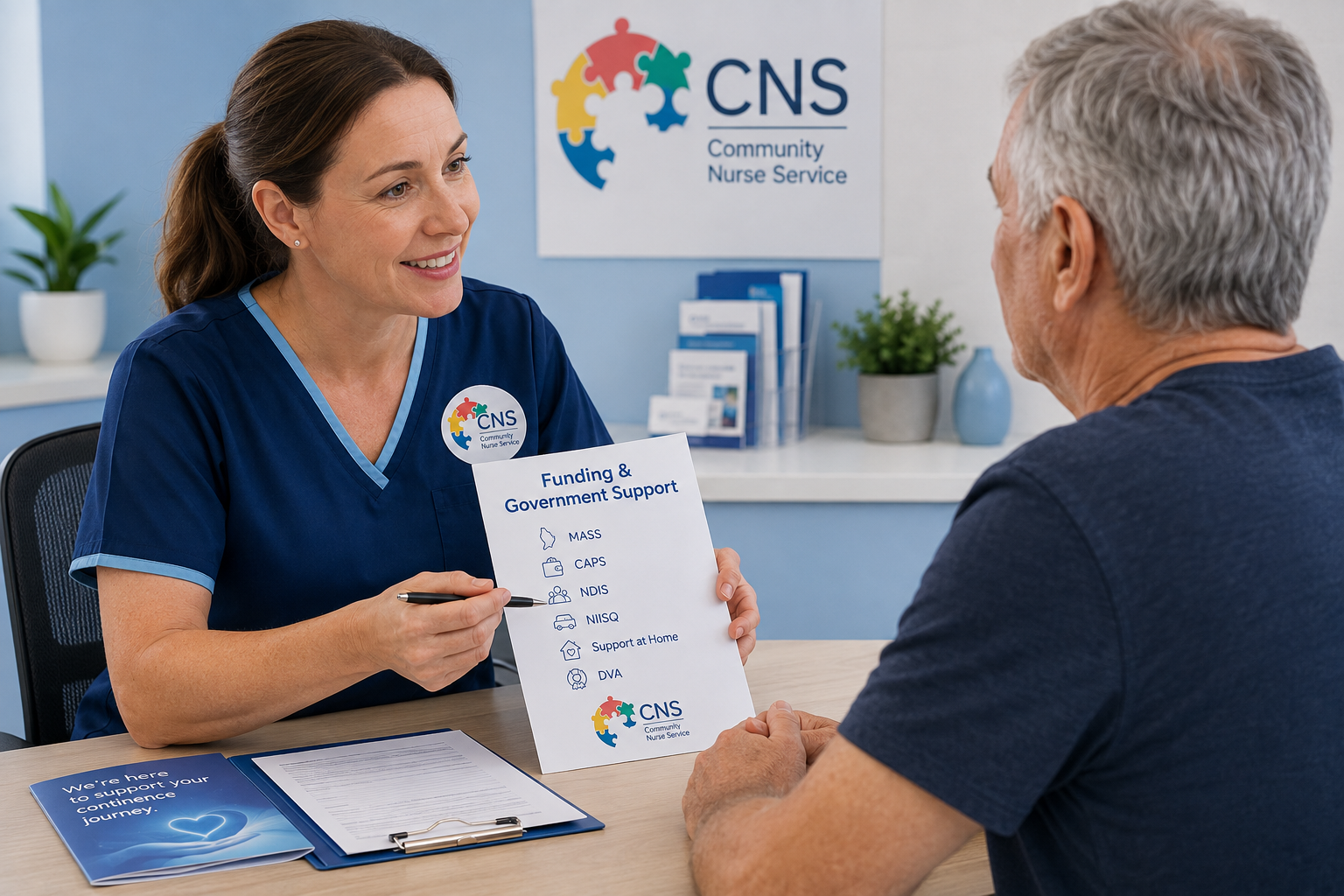
Funding & Government Support
Understanding your options for catheter and continence support
-
Helping eligible Queenslanders access continence and catheter products.
The Medical Aids Subsidy Scheme (MASS) is a Queensland Government program that provides subsidy funding for medical aids and equipment to eligible Queensland residents with a permanent and stabilised condition or disability.
For people living with bladder or bowel dysfunction, MASS may provide subsidised access to a range of continence and catheter products.
Importantly, MASS is a subsidy scheme. Eligibility and the products that can be supplied are determined by MASS requirements and clinical criteria.
What continence products can MASS provide?
MASS currently provides subsidy funding for eligible children and adults requiring continence aids. Products available through the scheme include:
Disposable pads, nappies, pull-on and all-in-one continence products
Reusable bed pads, chair pads and continence pants
Indwelling urinary catheters
Intermittent/disposable catheters
Catheter valves
Urinary sheaths
Leg drainage bags
Night drainage bags
Stretch pants when supplied with eligible non-adhesive shaped pads
Products must meet MASS requirements and be selected from the products available through the scheme.
Who may be eligible?
For general MASS assistance, you will usually need to meet both administrative and clinical eligibility requirements.
You may be eligible if you are a permanent Queensland resident, have a permanent or stable condition or disability, meet the specific clinical criteria for the continence aids being requested, and hold an eligible concession card in your own name.
Eligible cards include:
Centrelink Pensioner Concession Card
Centrelink Health Care Card
DVA Pensioner Concession Card — conditions apply
Queensland Government Seniors Card
The current MASS General Guidelines specifically state that the Commonwealth Seniors Health Card is not an eligible card for MASS services.
What does “permanent and stabilised” mean?
For continence aids, MASS describes this as a condition where the diagnosis is known and continence aids are expected to be required long term.
Before funding is approved, potentially treatable causes of incontinence should have been appropriately assessed and managed. The assessment considers the person's medical conditions, contributing factors, relevant co-morbidities and activities of daily living.
In other words, having bladder or bowel leakage alone does not automatically mean someone qualifies for MASS. There needs to be an appropriate clinical assessment and justification for the continence products being prescribed.
When might I NOT be eligible for MASS?
This is important because some people are eligible for continence support — but through another funding program rather than MASS.
MASS exclusions include people who are eligible to receive relevant assistive technology through programs such as the NDIS, NIISQ, DVA or residential aged-care funding. Hospital inpatients and some other funded circumstances are also excluded under the MASS General Guidelines.
Children under five years of age are not eligible for continence pads and nappies through general MASS, reflecting the fact that continence products may be developmentally expected at younger ages.
There are also separate arrangements for some people receiving palliative care.
Not eligible for MASS does not necessarily mean you cannot receive assistance. Another funding pathway — such as CAPS, NDIS, NIISQ, DVA or aged-care funding — may be more appropriate.
How do I apply?
Queensland Health advises that applicants need to arrange a clinical assessment with a health professional approved by MASS to prescribe the particular aid or equipment required. The prescriber then assists with the application and/or submits it on the applicant's behalf.
We can assess and apply for you.
You don't have to navigate the MASS continence application process alone.
Our Continence Specialist Nurses are recognised by MASS as eligible continence-aid prescribers.
We can complete a comprehensive continence assessment, identify your bladder and/or bowel needs, discuss suitable continence and catheter products, determine whether your circumstances appear to meet MASS requirements, and complete and submit the appropriate MASS continence application on your behalf.
Our role is to ensure that the products requested are clinically appropriate for you — not simply to recommend a particular brand.
Please note: Assessment by our Continence Specialist Nurse does not guarantee MASS approval. Final eligibility and funding decisions remain with the Medical Aids Subsidy Scheme.
What happens after approval?
For continence aids, MASS advises that ongoing supply requires a clinical review every three years, or an application where there is a change to the type of continence aids required.
Where there has been no change to the type of continence products prescribed, MASS advises that clients/carers and prescribers may be able to contact MASS directly for reorders.
Official MASS information
MASS – Queensland Health
Visit the official MASS websiteCheck whether you may be eligible
MASS eligibility and applyingContinence aids through MASS
MASS continence aids information
Need help with a MASS continence application?
Book a continence assessment with one of our Continence Specialist Nurses.
We can assess your continence needs, discuss appropriate products and, where you meet the relevant requirements, prepare and submit your MASS continence application on your behalf.
-
The Continence Aids Payment Scheme (CAPS) is an Australian Government program that provides an annual, non-taxable payment to eligible people who experience permanent and severe incontinence.
Rather than supplying particular products, CAPS provides money to help with the cost of continence and continence-related products, giving you flexibility to purchase products from the supplier of your choice.
How much is the CAPS payment?
For the 2026–27 financial year, CAPS provides up to $739.40 per eligible person.
You can choose to receive the payment:
Annually — generally paid in July; or
Twice yearly — generally paid in July and January.For a new application, the first payment may be calculated on a pro-rata basis from the date Services Australia receives the complete application. CAPS is not retrospective, so it is worth applying once eligibility has been established rather than delaying unnecessarily.
The payment is not included as taxable income.
Who may be eligible for CAPS?
To receive CAPS, you must meet all of the applicable eligibility requirements.
Generally, you must:
Be 5 years of age or older
Have permanent and severe bladder and/or bowel incontinence
Have the incontinence confirmed by an appropriate registered health professional
Have an eligible neurological or other medical condition
Meet Australian residency requirements.
For CAPS purposes, permanent and severe incontinence involves frequent and uncontrollable moderate-to-large loss of urine or faeces, which affects quality of life and is not expected to improve with appropriate medical, surgical or clinical treatment.
What conditions are eligible?
CAPS has specific lists of eligible neurological conditions and eligible other conditions.
Importantly, the rules are slightly different depending on the underlying condition.
People with an eligible neurological condition may qualify without holding a concession card.
If the incontinence is caused by an eligible non-neurological condition, the person must also hold an eligible Pensioner Concession Card issued by Services Australia or the Department of Veterans' Affairs.
hen are you NOT eligible for CAPS?
You generally cannot receive CAPS where:
The incontinence is temporary rather than permanent and severe
The incontinence is considered treatable
The only issue is night-time bedwetting
You permanently live in an Australian Government-funded residential aged-care facility
Your NDIS plan already includes continence support
You have certain DVA entitlements and can receive continence assistance through the Rehabilitation Appliances Program
You are in prison
You have been living overseas for three or more consecutive years.
There are also specific rules affecting some people receiving Australian Government-funded home care, so this should be checked against the person's individual circumstances rather than assuming CAPS is automatically excluded.
Services Australia specifically states that a person can receive CAPS and Support at Home at the same time if they meet the CAPS eligibility criteria. However, exclusions can apply to people whose Australian Government-funded home-care arrangements already included continence-aid support before 1 November 2025.
What can I use CAPS for?
CAPS is intended to help with the cost of continence and continence-related products.
Unlike MASS, you are not restricted to purchasing products from a particular CAPS product list or supplier. Services Australia advises that recipients can purchase products from a seller of their choice, including pharmacies, supermarkets and online or telephone suppliers.
You also do not need to provide receipts to Services Australia for the products you purchase.
And this is where I would bring Catheter Help's philosophy back in:
Choosing the right products matters
Receiving CAPS doesn't necessarily tell you which continence products are appropriate for you.
A continence assessment can help identify your bladder and bowel needs, appropriate absorbency, sizing, catheter-related requirements and other products that may make continence management safer, more comfortable and more effective.
Our advice is based on your individual clinical needs — not on selling you a particular brand.
How do I apply for CAPS?
If you're applying for yourself and have Medicare linked to myGov, you can apply online through your Medicare account.
However, there is an important clinical step first.
Before the application can be completed, an appropriate registered health professional must complete the Health Report confirming your incontinence, its cause and the relevant clinical information.
Services Australia specifically recognises continence nurses and registered nurses, among other health professionals, as professionals who can complete the required assessment where they are able to accurately assess the person's incontinence and its cause.
We can assess and assist with your CAPS application
You don't have to work out the clinical side of your CAPS application on your own.
Our Continence Specialist Nurses can complete a comprehensive continence assessment, review the nature and severity of your bladder and/or bowel incontinence, consider the underlying condition and discuss whether you appear to meet the CAPS clinical eligibility requirements.
Where appropriate, we can also complete the Health Report required to support your CAPS application and guide you through the application process.
The application itself can then be submitted through Medicare online via myGov or using the official CAPS application form, depending on your circumstances.
Please note: A continence assessment or completion of the CAPS Health Report does not guarantee approval. Final eligibility and payment decisions are made by Services Australia.
MASS or CAPS — what's the difference?
MASS is a Queensland Government subsidy scheme through which eligible Queenslanders can access approved continence and catheter products.
CAPS is an Australian Government payment that contributes towards the cost of continence products and allows eligible recipients to purchase products from the supplier of their choice.
Depending on your circumstances and other funding arrangements, your Continence Specialist Nurse can help you understand which pathway may be appropriate.
Official CAPS information
And one particularly useful button:
-
For eligible participants whose continence, catheter or nursing support needs are related to their disability. This could cover appropriate consumables and, where applicable, nursing/health supports.
-
Support for eligible people who sustain serious personal injuries in motor vehicle accidents in Queensland. This one is particularly relevant to some of the complex catheter clients CNS sees.
-
For eligible older Australians receiving aged-care support at home. We'd explain where continence products/nursing may fit within the program without implying everything is automatically funded.
-
Eligible veterans and DVA clients may be able to access continence products, catheter supplies and community nursing through DVA-funded arrangements.
-
You can still access our services privately. Community Nurse Service is an independent healthcare provider and is not directly funded by the Australian or Queensland Government. Some clients may be able to access our services through an approved funding program where eligible, while others choose to pay privately.
Some private health insurance policies may provide benefits for certain nursing services or procedures under Extras cover, depending on your insurer, level of cover and the service provided.
We recommend contacting your private health insurer before your appointment to confirm whether your particular service is eligible for a benefit.
Where appropriate, we can provide you with an invoice and an accompanying clinical letter outlining the service or procedure provided to support your claim. However, reimbursement is determined entirely by your private health insurer and cannot be guaranteed.
No funding? You can still see us.
You do not need to be an NDIS participant, DVA client or receive government-funded support to book an appointment with us. Private appointments are available, including telephone consultations, clinic appointments and in-home nursing services.